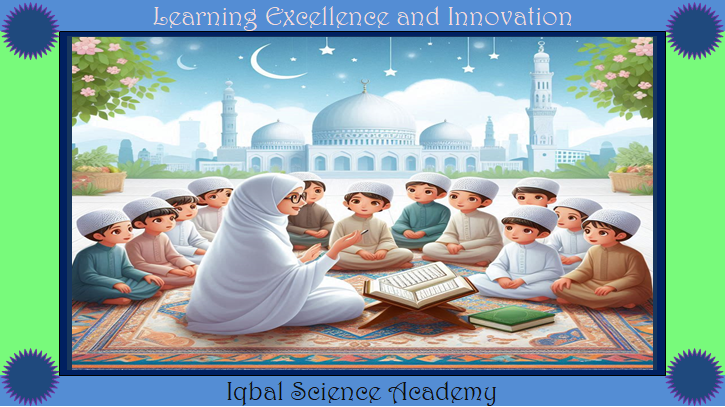
The Quran is the central document of the Islamic faith. Islam is a comprehensive code of conduct that addresses practically every aspect of everyday existence and instructs its adherents on what to do and how to accomplish it in a certain circumstance. It is written in the Holy Quran,
“Do not make the calling of the teacher among you as you are calling one of another.”
The verse affirms the standing of instructors in society, i.e., that Islam has accorded them a respectable position. It also advises followers to treat their professors with decency and not to address them in the same manner as they address each other. The prophets of Allah were all mentors and educators for humanity in the Islamic world. The teaching and instruction of others is one of their duties, according to the Holy Quran. As it is written in the Holy Quran that prophets of Allah were the teachers, this statement indicates that the teachers have equal status to the status of the prophets.
As prophets were being respected by their followers the teachers should also be paid an equal amount of respect.
The Holy Prophet Muhammad (PBUH) said,
“Seek knowledge and train to be dignified and calm while seeking knowledge, and humble yourselves with those whom you learn from”.
This remark is essentially advising the kids to treat their teachers with decency and civility. When students are chatting with their professors, they must keep their gaze down and moderate the level of their voice.
Teachers have a critical role in preparing the next generation of learners to work effectively. Muslim educators are doing a fantastic job educating the next generation of society’s youth. He is in charge of teaching the pupils about Islam in addition to the course material. Numerous Muslims work as teachers in several countries, specializing in different disciplines. There are non-Muslim nations where Muslims serve as educators. Many non-Muslim nations do not educate about Islam and do not even offer a course on it.
Muslim teachers can show the importance of Islam through their behavior in non-Muslim countries. He must follow the teachings of Islam and make others follow as per their willingness.
The Quranic Perspective on Teacher Education
Islam mainly emphasizes character building so teachers’ training is also mainly based on different aspects of life. There are some responsibilities of teachers that necessarily be inculcated among their students.
i. Forgiveness
Allah (SWT) reminds us in the Holy Qur’an:
It is He Who sent among the unlettered people a Messenger from among themselves, who recites to them His signs and purifies them and bestows them the knowledge of the Book and wisdom, although they had been necessarily in manifest error before that. (Sura: 62, Verse: 2).
It is written in the Holy Quran that,
“Show forgiveness, enjoin what is good, and turn away from the foolish (i.e., don’t punish them).”[Quran 7:199].
It is a guidance for Muslims or believers to provide forgiveness to others. However, it has been noted that some educators penalize their pupils excessively when they make mistakes or act incorrectly. It should be their highest responsibility to pardon their pupils for any errors that they may have made.
At another place in the Holy Quran it is said:
“And verily, whosoever shows patience and forgives that would truly be from the things recommended by Allah”. (Qur’an, 42:43).
It implies that if we have patience and forgive people, they will be able to act in the way that Almighty Allah has demanded. This implies that instructors must be patient with their pupils and be willing to forgive them if they make any mistakes. If a student’s behavior is below par, they should not use physical punishment.
Students may learn to forgive others via their teachers. It occurs in class that students argue with one another over trivial matters, cease interacting, and act haughty. Now that this is the Sunnah of our Prophet (SAW), the teacher can help them to forgive one another.
ii. Good Conduct
Akhlaq is an Arabic term referring to the practice of virtue, morality, and good manners in Islamic Theology and Philosophy (Falsafah). It is most commonly translated in English as; Islamic behavior, disposition, good conduct, nature, temper, ethics, morals, or character (of a person).
Akhlaq is the plural of the word Khulq which means disposition. “Disposition” is the faculty (Malakah) of the soul (Nafs) which is the source of all those activities that man performs spontaneously without thinking about them. Malakah is a property of the soul that comes into existence through exercise and repetitive practice and is not easily destroyed. A particular disposition (Malakah) may appear in human beings because of one of the following reasons:
- Natural and physical makeup (Fitrah):
It is observed that some people are patient while others are touchy and nervous. Some are easily disturbed and saddened while others show greater resistance and resilience. - Habit (Ada):
It is formed because of the continual repetition of certain acts and leads to the emergence of a certain disposition. - Practice and conscious effort:
Which if continued long enough will eventually lead to the formation of a disposition.
“Blessed is He in whose hands are the Kingdom – who is powerful over everything – who has created death and life, so that He might test you as to which among you is good in conduct.”
(Al-Mulk 67: 1-2)
The Holy Quranic verse mentioned above tells us that being virtuous is the only way to receive the favors and blessings of Almighty Allah. Because educators serve as role models for their children, this stanza instills in them the need to maintain proper behavior on school grounds. Pupils attempt to imitate their educators. It is unrealistic to expect a country to advance or thrive in the world if its professors behave badly. To illustrate: Instructors need to impart to their pupils polite social behavior. Teachers must help students who behave properly if they talk badly to other people or show disrespect for seniors and younger people. Teachers need to instill in their students the idea that this is essentially what defines our personalities—our akhlaq. A teacher must foster the whole development of each student’s personality.
Read: The relevance and scope of teacher education in Pakistan
iii. Humble Behaviour
Humbleness is the opposite of arrogance and is an attitude and behavior that Allah and His Messenger (Peace and blessings be upon him) have commanded us to have. It is also a great tool used to spread Islam to others.
The best way to achieve humbleness in the heart is contained in the Sunnah of the Messenger of Allah (Peace and blessings be upon him), who prescribed many methods to teach his companions how to be humble. We ask Allah to help us all become humble and stay firm on that path.
“The true servants of the Most Merciful are those who behave gently and with humility on earth, and whenever the foolish quarrel with them, that reply with (words of) peace.”
(Al-Furqan)
The above verse of the Holy Quran gives us the message of mercifulness and advises us that we should not treat foolishness in the same way as they treat us. This means that your students sometimes behave in such a way that is not required then teachers need to teach them humbly. It has been found by research scholars that if we treat students humbly, then our response will bring change in their behavior.
iv. Justice
Justice in the context of Islam refers to putting things in their proper places. It also entails treating everyone equally. Similar to the Western tradition, fairness is seen in Islam as a moral virtue and a characteristic of human nature. Although they are not the same, justice and equality are similar in that they establish a condition of balance in the allocation of rights and obligations. According to the Quran, the holy book of Islam, fairness is the highest virtue. It is a fundamental goal of Islam to the extent that it comes after the conviction that Muhammad is truly a prophet and that God has the exclusive right to be worshipped (Tawheed).
God declares in the Quran:
“God commands justice and fair dealing…” [Quran, 16:90]
In this verse, Allah directly commands Muslims to be just and deal fairly – as believers, we must consistently be aware that these values are an integral part of our faith.
Teachers must do justice at the time of doing student evaluation. They must not show a biased attitude. Commonly, some students get affected due to the favoritism of teachers.
v. Patience
Patience (sabr) is a comprehensive virtue in Islam that encompasses perseverance, endurance, forbearance, diligence, and restraint. It is a characteristic of enlightenment in the heart of Muslims.
. وَاصْبِرُوا إِنَّ اللهََّ مَعَ الصَّابِرِینَ . .
…and be patient. Indeed, Allah is with the patient.” (Al-Anfal 8:46)
Muslims are urged to exercise patience in this verse of the Holy Quran because Allah would support those who do so during good times and bad. Teachers in the modern day must adopt this mindset in their students when they arrive for class. They must remember that their kids are still children, and as they are not adults, they should not be held responsible for their mistakes. Instead, they should be kind and patient with their students when they make mistakes.
وَاسْتَعِینُوا بِالصَّبْرِ وَالصَّلاَةِ
“And seek assistance through patience and prayer…” (Al-Baqarah 2:45)
This verse from the Holy Quran reminds us to be patient, and it advises believers to ask for help via prayer and patience. It implies that educators who encounter any type of challenge in their day-to-day work should turn to prayer. Rather than taking matters into their own hands, teachers ought to pray for the pupils who are misbehaving in their courses.
vi. Doing Good Deeds and Counselling One Another about the Truth
“By time, indeed, mankind is in loss, Except for those who have believed and done righteous deeds and advised each other to truth and advised each other to patience.” …….(Al-Asr 103:1-3)
The Holy Quranic verse mentioned above imparts two lessons to us: patience and honesty. This implies that since lying is wrong in the sight of the Almighty Allah, we must live truthful lives and refrain from lying. According to the aforementioned scripture, people who commit wrongdoing in this life will lose everything because Allah Ta’ala will judge them according to their actions.
“Only those who are patient shall receive their reward in full, without reckoning.” (39:10)
This verse from the Holy Quran tells us that individuals who practice patience in their lives will receive a recompense. This implies that if students’ answers fall short of what is expected, teachers should still be courteous to them, exercise patience, and let God handle justice. If this is done, they will undoubtedly receive an endless reward, as Allah has promised to all of humanity.
“O you, who has believed, fears Allah and speaks words of appropriate justice.” (Al-ahzab 33: 80)
This verse from the Holy Quran tells believers that they should always be afraid of Allah in all aspects of their lives. They ought to uphold justice in their own lives and refrain from allowing injustice to proliferate in society. When we act justly towards others, we demonstrate our fear of Allah. It is the wisdom of those who fear Allah. It implies that educators must exercise caution when performing any task during assigned time. If they fail to uphold justice in the classroom, it would be evident that they lack fear of Allah Ta’ala.
vii. Fear of Allah
One of the divine principles that Islam teaches people is to love Allah but to fear him as well. The believer should be connected to His Lord, whose bounties, grace, and generosity are endless, with great love and respect; he should think that His compassion and mercy surround everything, and he should not give up hope of being forgiven no matter what his sins are.
“O you, who has believed, fear Allah and be with those who are true.” (Al–Taubah 9:119)
This verse of the Holy Quran is having something more for the believers and it advised that they need to give support to those who are true. This means that we need to be on the side of a righteous people, we should favor those who are doing wrong then surely we will get blessings of Allah.
Muslim teachers can deal with all types of situations of students, which are related to their course contents as well as their routine life, and effectively guide them. Through this guidance, the students could solve their problems of studies as well as the problems of routine life. Due to the many qualities of a Muslim teacher his demand and fame are increasing with time.
Educators must understand that they are assigned a set of curricula to follow in the classroom. Muslims believe that we shall be held responsible for all of our deeds. Therefore, we shall be held accountable for all of our professional actions as teachers. We should be afraid of Allah because of this. We should firmly trust that Allah will punish us for any wrongdoing on our part. Following such an extensive discourse, it is determined that Muslims are expected to adhere to certain mandated principles. Educators who uphold these principles in their work will succeed both now and in the future.
Follow: ISA Blog